Byron Harmon: Selected Views of the Canadian Rockies 1905-1934

Byron Harmon, 1929, Banff Winter Carnival on Banff Avenue || was dreamed up by the Board of Trade of which Byron was a founding member. It aimed to entertain the locals as well as attracting tourists to create a bit of revenue in the lean years following the First World War. There were races, an ice palace, a toboggan slide ending on Banff Avenue, and a parade.
Banff Winter Carnival was dreamed up by the Board of Trade in Banff, of which Byron was a member. It aimed to entertain the locals as well as attracting tourists to create a bit of revenue in the lean years following the First World War. There were races, an ice palace, a toboggan slide ending on Banff Avenue, and a parade.
The teepees were contributed by the Stoney nations who live east of Banff National Park on the Mînî Thnî, (formerly known as Morley) Reserve. They participated in this festival, as well as Banff Indian Days, as a way of educating the public about their culture and heritage.
> PURCHASE INFORMATION

Byron Harmon, Banff Businessmen Fishing in the Kananaskis Valley || Kananaskis Lakes , between Banff and Calgary, were a great place to fish: wild, unregulated and outside of the National Parks, until construction of hydro-electric dams beginning in the 1940’s.
> PURCHASE INFORMATION

Byron Harmon, 1910, Tom Longstaff and Guide Billy Batz? in the Purcell Mountains. ||
British doctor, explorer, and mountaineer, Tom George Longstaff, was already famous for his climbs and explorations in the Himalayas when A. O. Wheeler invited him to join him, Byron Harmon, and guide Conrad Kain in exploring the remote Purcell Mountains west of the Rockies.
> PURCHASE INFORMATION

Byron Harmon, 1910, Bugaboo Glacier in the Purcell Mountains, BC || Byron Harmon is credited with ‘discovering’ Bugaboo Glacier in 1910. Undoubtedly it was known to Indigenous tribes and local prospectors but he was the first person to photograph it. It was briefly called Harmon’s Great Glacier, before the romantic name, Bugaboo, captured everyone’s imagination. This area is now one of the most treasured climbing areas in the world.
> PURCHASE INFORMATION

Byron Harmon, 1909, Climbing Mt. Marpole, Yoho National Park || Swiss guide, Edward Feuz Jr, leads this climb. This photograph was part of Canada Post’s Canadian Photographer series, issued April 13, 2016.
> PURCHASE INFORMATION

Byron Harmon, 1923, Canoeing on Cross River, Kootenay National Park || Until Windermere Highway, (now Highway 93) opened, in 1923, Kootenay National Park was deep wilderness. Byron, who had championed this highway, celebrated the occasion of its opening with a canoe trip down Kootenay River, of which Cross River is a tributary, in order to photograph staged dramatic scenes with canoes.
> PURCHASE INFORMATION

Byron Harmon, 1923, Cross River Falls, Kootenay National Park || The canoe for this excursion was carried to the Kootenay River on top of the truck seen in Sinclair Canyon, in another image of this collection. This trip was filmed and photographed, including a scene of a capsized canoe.
> PURCHASE INFORMATION

Byron Harmon, late 1920's, Diver at Chateau Lake Louise || The diver in this photograph appears to be a woman, but it was suggested to me by my friend and fellow Banffite, Herbie MacAulay, that it was likely his father, Jack MacAulay, who was a champion diver in his youth.
> PURCHASE INFORMATION

Byron Harmon, 1910, Gentlemen's Quarters at Consolation Valley Alpine Club of Canada Camp || Alpine Club of Canada Camps were located in remote areas where both men and women slept in canvas wall tents; a large cook tent and wooden picnic tables were communal. All of this had to be transported by horse to the site of the camp and taken down afterwards.
> PURCHASE INFORMATION

Byron Harmon, 1927, Helen Breese Walcott at Mt. Assiniboine with the Trail Riders of the Canadian Rockies || Helen Breeze Walcott was the daughter of Charles Doolittle Walcott, Secretary of the Smithsonian Institution and a palaeontologist. He had a great interest in the Canadian Rockies and attended ACC Camps with his children. He was a founding member of Trail Riders of the Canadian Rockies.
> PURCHASE INFORMATION

Byron Harmon, 1908, Ice Cave in Bow Glacier || Ice caves are mysterious caverns which form in glaciers as a result of melting water on the glacier’s surface which erodes tunnels and chasms in the ice. In 1908 an ACC group crossed the Continental Divide from Yoho Glacier to Bow Lake on the Waputik Icefield which lays along the Divide.
> PURCHASE INFORMATION

Byron Harmon, 1932, Ike Mills and Mt. Redoubt, Canadian Rockies || Ike Mills was a remittance man from England who settled in Banff and established a business which rented out horses in summer and dogsled excursions in winter. He volunteered his veterinary skills in Calgary on occasion.
> PURCHASE INFORMATION

Byron Harmon, 1922, Lake of the Hanging Glaciers, Conrad Kain on the icewall. || Lake of the Hanging Glaciers is located in the Purcell Mountains in the headwaters of Columbia River. The famous ice wall in this photograph has since melted back to the shore of the lake. The lake, which used to be filled with icebergs calved from overhanging glaciers, now has a few lazy chunks floating on the surface, mute testament to climate warming.
> PURCHASE INFORMATION

Byron Harmon, 1920, Lewis Freeman's Party at Horsethief (now Starbird) Glacier, Purcell Mountains || Byron Harmon and Lewis Freeman, an American adventure travel writer and photographer, met at Lake of the Hanging Glaciers in 1920. Freeman was embarking on a commission by Chester-Outing-Pictures to film his descent, with a camera-man, of Columbia River by boat.
> PURCHASE INFORMATION

Byron Harmon, 1908 or 1918, Swiss Guides on Asulkan Pass in the Selkirk Range || Swiss Guides, were brought to Canada each summer, by the CPR, to guide guests of CPR hotels. The Alpine Club of Canada summer camp was situated nearby in 1908 and Swiss guides were loaned to the club to guide their climbs in the Rogers Pass area.
> PURCHASE INFORMATION
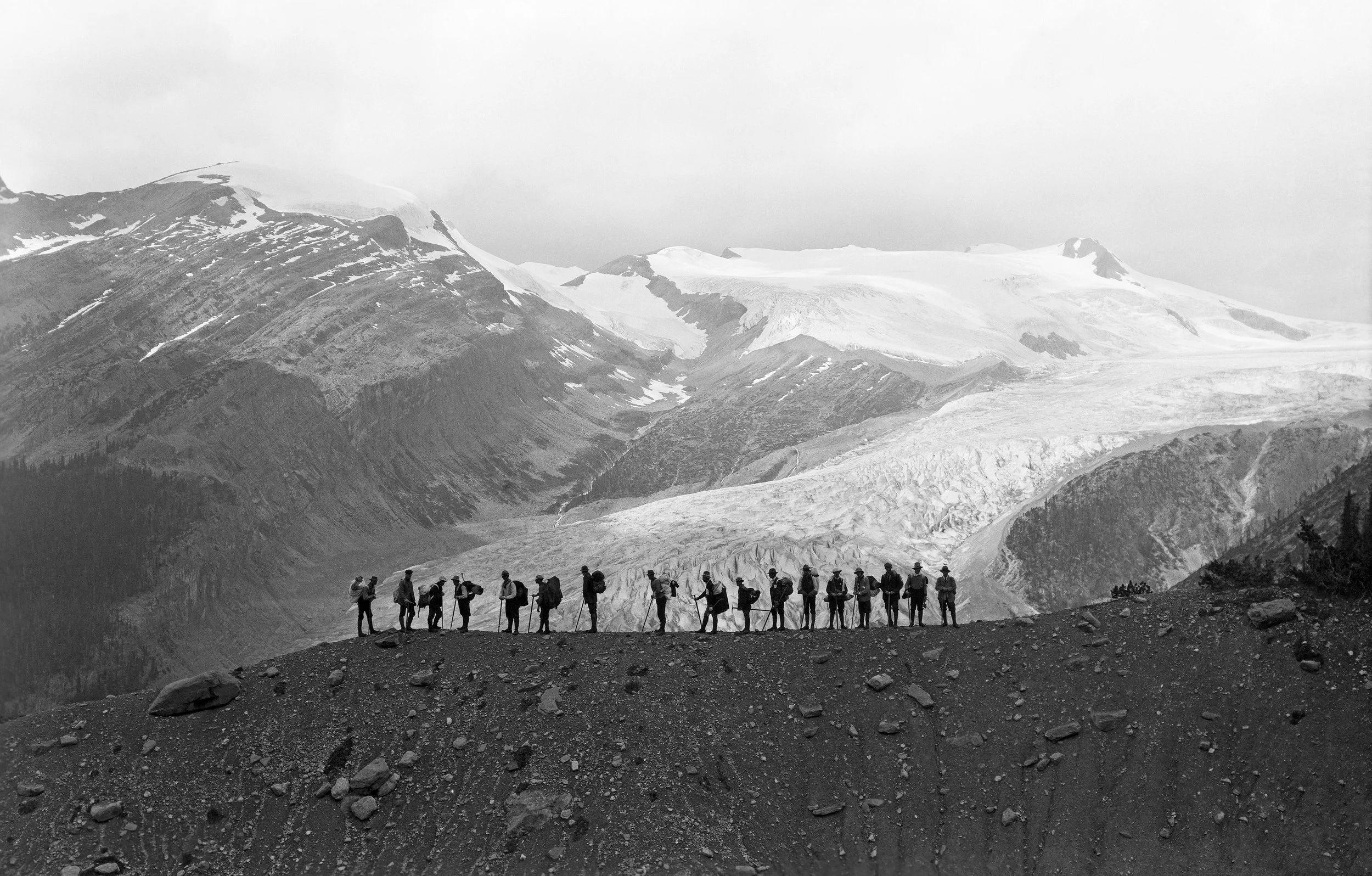
Byron Harmon, 1908, The Alpine Club of Canada at Yoho Glacier || As early as 1900 studies were underway to record the rapid recession of Yoho Glacier and other prominent glaciers in the Canadian Rockies. Excursions of the ACC were used to carry out some of this work.
> PURCHASE INFORMATION

Byron Harmon, 1923, Truck carrying a canoe through Sinclair Canyon after the opening of Windermere Highway || Through his photography, Byron Harmon actively promoted the creation of Windermere Highway which connects the junction of the Trans Canada Highway at Castle Mountain, west of Banff, with the Windermere and Columbia Valleys in south-western British Columbia.
> PURCHASE INFORMATION

Byron Harmon, 1906, The First Alpine Club of Canada Camp in Yoho Valley, Yoho National Park. || The Alpine Club of Canada was the first mountaineering club in the world to welcome women as charter members. They quickly cast aside their skirts for the more convenient and safe bloomers, which then gave way to knickers and socks, with protective bandaging of calves, used by both men and women. Mrs. Imogene Wheeler, centre, was the wife of A.O. Wheeler, the Director of the A.C.C. for many years.
> PURCHASE INFORMATION

Byron Harmon, 1934, Aileen Harmon at Mt. Assiniboine || The new sport of cross-country skiing was introduced to the Canadian Rockies by Norwegian ski instructor, Erling Strom, who built the first ski lodge in the Canadian Rockies at Mt. Assiniboine in 1928. With his daughter, Aileen, and Ike Mills with his dog team, Byron travelled to Assiniboine Valley in 1934 to photograph new and old ways of navigating and enjoying a Canadian winter.
> PURCHASE INFORMATION

Byron Harmon, 1932, Skiers at Skoki, Near Lake Louise || Byron didn’t ski; he used dogsleds and snowshoes for winter travel. The three skiers in this photograph are likely Rupert Edwards and Cyril Paris of Banff, and Byron’s son, Lloyd; I don’t know who is who.
> PURCHASE INFORMATION
