Portrait | Landscape
Byron Harmon started out as a portrait photographer.
A favourite family story relates that Byron builds his first camera from designs in a magazine. After paying the rent, and equipping his new studio, he has no money left for film. His first clients are newly-weds. He pretends to take their portrait, with payment in advance, then dashes out and buys film. When they return for their prints, the next day, he tells them he isn’t happy with the original shots and will redo them for free.
In 1899 a group of friends chips in funds to help him open this studio. Soon he is off, however, to photograph the Indigenous tribes of the western prairies in the USA. He travels by train and on horseback, possibly employing a covered wagon as a studio, visiting tribes and photographing the people he encounters. He makes tintype photographs (ferrotypes), which are one-of-a-kind images made using thin sheets of metal, available in a number of sizes, coated with a light sensitive gelatine or collodian emulsion. A sort of poor man’s daguerreotype, in that the materials and chemicals used are much less costly but the process is similar. His camera consists of a wooden frame to hold a single photographic plate, connected by a light-tight bellows to a parallel lens. This camera is mounted on a tripod. Photographic plates are prepared with a black coating underneath the emulsion so that the negative image, which is reversed left to right, appears as a positive on the finished plate.
In 1901 he published his first photo book, Indians of the Western Prairies: Photogravures. A copy is held in the Thomas Fisher Rare Book Library at University of Toronto. It is missing its front cover. Digital copies of this book are listed in a number of North American libraries. It is the only physical copy I know of.
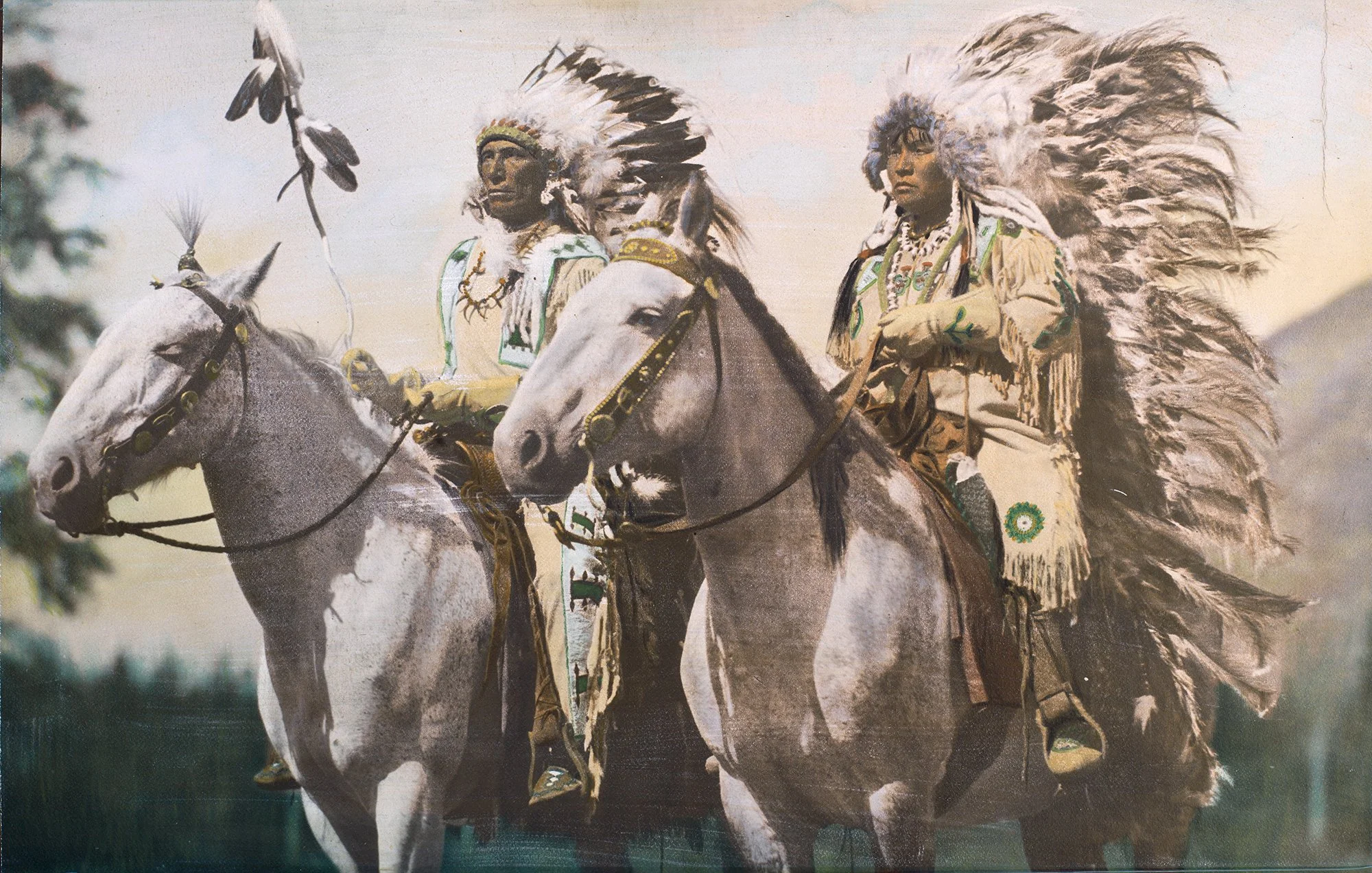
Chief Sitting Eagle, John Hunter, and his wife Leah Rider Hunter, Banff Indian Days, Byron Harmon photo, colourist unknown
This portrait is one of many Indigenous portraits Byron made near Banff, at Banff Indian Days, on the Stoney Nakoda Reserve at Morley, and in the Columbia Valley in the Selkirk Mountains where he kept a small farm as a launching place for his mountain adventures.
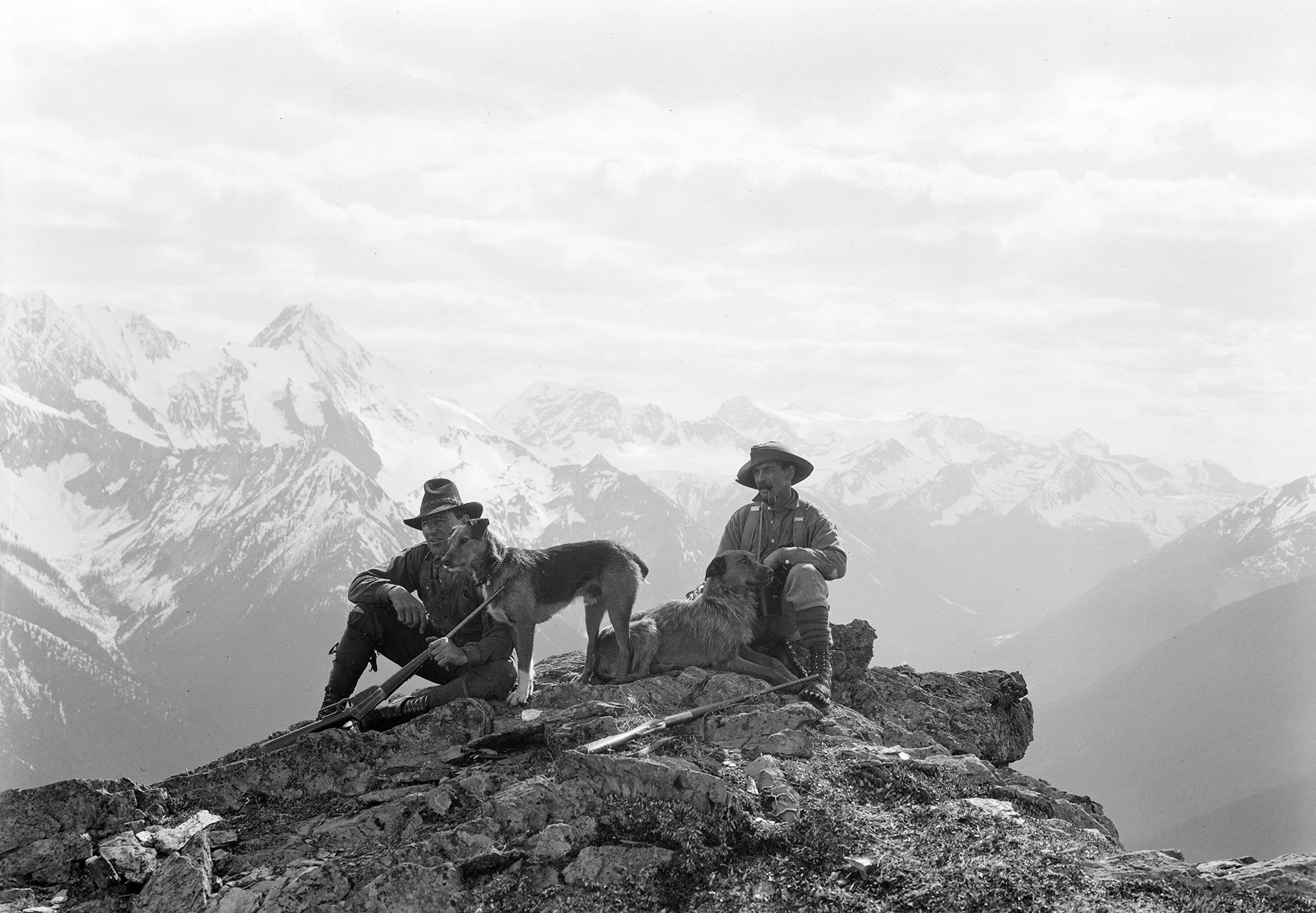
A Byron Harmon photograph of trapper and guide Billy Batz, with his dogs, and Tom Longstaff, a British climber renowned for his Himalayan adventures, with the Purcell Mountains in the distance, 1910.
I have often thought of Byron’s entire body of work as a portrait of an environment and a period. A passing era. A last wilderness.