Soapy Smith and the Horses
I have been contemplating the vanishing influence of horses in our lives. Until the twentieth century, and even in the late nineteenth century, horses were crucial to city as well as country life in the western world. We rode them for pleasure, they carried our goods, bore us into battle, drew our carriages. Horses were loved—sometimes abused. They were everywhere. The internal combustion engine changed all that.
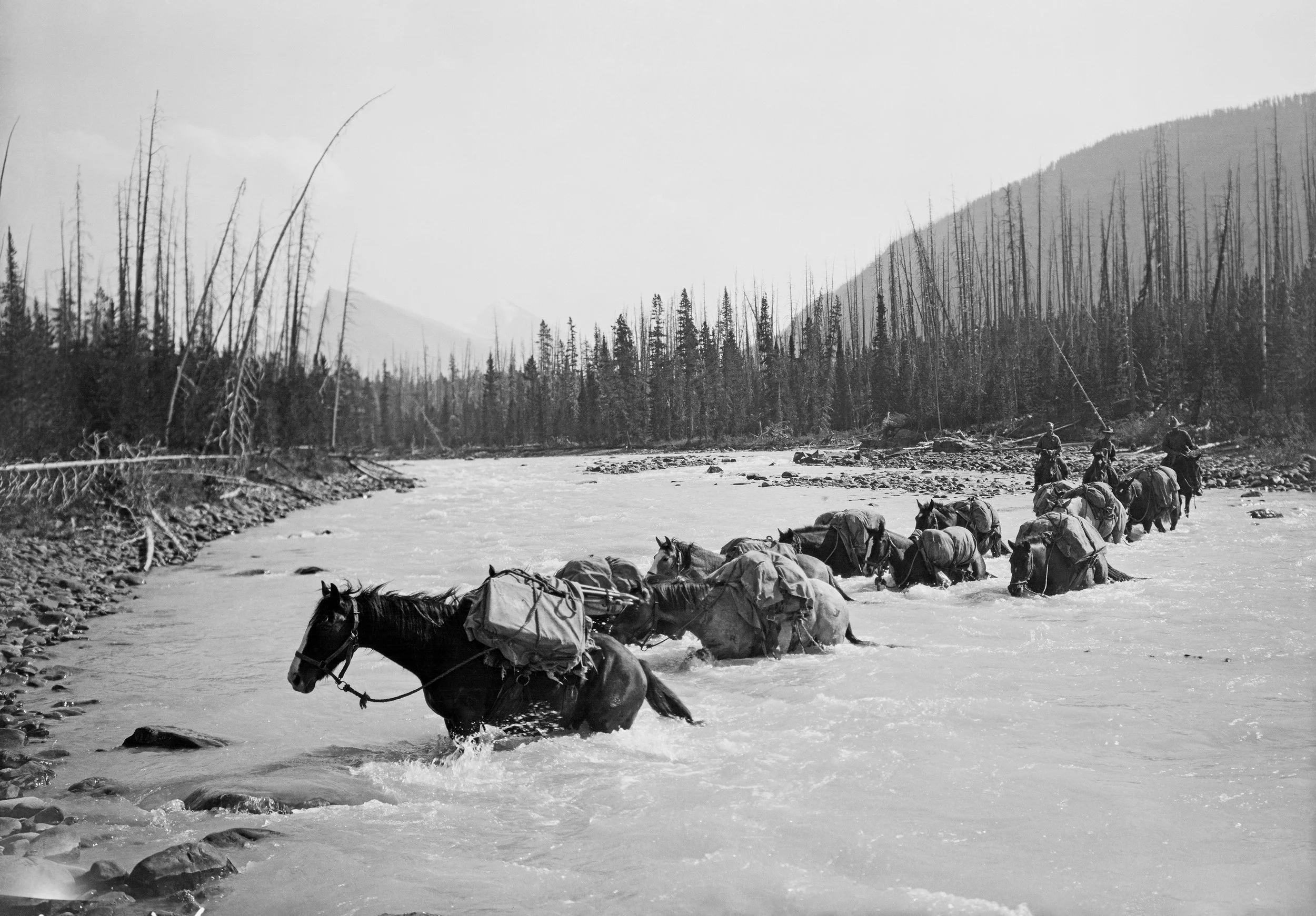
Byron Harmon, 1924, Packtrain Fording Sunwapta River
The ranch of Canadian artist, Maureen Ens, west of Calgary, is full of her marvelous paintings. Horses, bears, her dog, Boots, prayer flags fluttering over Canadian mountain landscapes. A wolf face peering from shadow, one of a pack which followed and co-existed with a herd of wild horses Maureen had studied and painted.
I was there, on September 21, 2026 for a gathering of the Rocky Mountain bookclub, a collection of climbers, guides, authors, historians, former wardens and mountain enthusiasts who had lived in or near the Canadian Rockies for years and share a love of mountain history and adventure. Their partners and wives were present as well for this annual barbecue and participated in the discussions.
We gathered in a pasture; Rick Kunelius, former Chief Wildlife Officer for Banff National Park, had built an admirable bonfire of tightly packed logs which broadcast heat and flakes of ash but no sparks, a feat I would like to better understand.
One of the books under discussion was Great Days in the Rockies, the photographs of Byron Harmon, 1906 - 1936, which I had worked on with Bart Robinson, who had invited me to this event, and which was published in 1978 by Oxford University Press. This is primarily a book of images and Bart had written the introduction about Byron Harmon.
The other book was Great Days in the Rockies, Lewis R. Freeman’s book about Byron’s 1924 Columbia Icefield Expedition, which he had been invited to join, to help with the photography. I suspect also in hope that he would later help publicize the film Byron planned to make. Freeman was an American adventure travel writer who Byron had met, in 1920, at Lake of the Hanging Glaciers in the Purcell Mountains.
Much of the discussion about the Columbia Icefield expedition centred on the horses. They were filmed and photographed swimming raging rivers with packs. Were they safe? Maureen confirmed that horses do sometimes die in river crossings but that Soapy Smith, whose outfit this was, was a consummate and experienced wrangler. This supports my interpretation, that the main storyline for the Columbia Icefield Expedition is the pack train journey; it’s all about the horses and their handlers. Soapy is the hero of the tale.

Byron Harmon, 1924, Soapy Smith leading the horses across Saskatchewan Glacier, Columbia Icefield
They were led across the ice of Columbia Icefield. Was this abuse of the horses, Bart asked? Maureen assured me, once the horses got the knack of walking on ice, they would have enjoyed this adventure. Although it was an arduous trip, there were no injuries or loss of life to horses, or the two dogs who were along and rode atop the packs on river crossings, nor the five humans whose flamboyant adventure this was.
Soapy Smith was an outfitter with a ranch near former Morley Reserve, in the foothills of the Canadian Rockies, now known by its Indigenous name, Mînî Thnî. Byron planned this expedition with Soapy for two years, choosing the horses carefully, and fattening them up for the entire summer of 1924.

Byron Harmon, 1924, Soapy Smith leading the horses up Poboktan Pass
One of Byron’s goals on this trip was to film the pack train crossing passes in the early snow of winter. He had experienced this before but never with movie camera along.
I believe Byron was well aware that mountain travel with a packtrain was a passing way of life, one which was destined to vanish for all but a handful of individuals. It was his own last major expedition, his swan song in a way. One of my favourite Byron Harmon photographs is the next one, of Mt. Quincey; a horse grazes by the shore. In the shadows, on the left of the image, is a movie camera on a tripod, facing the photographer.
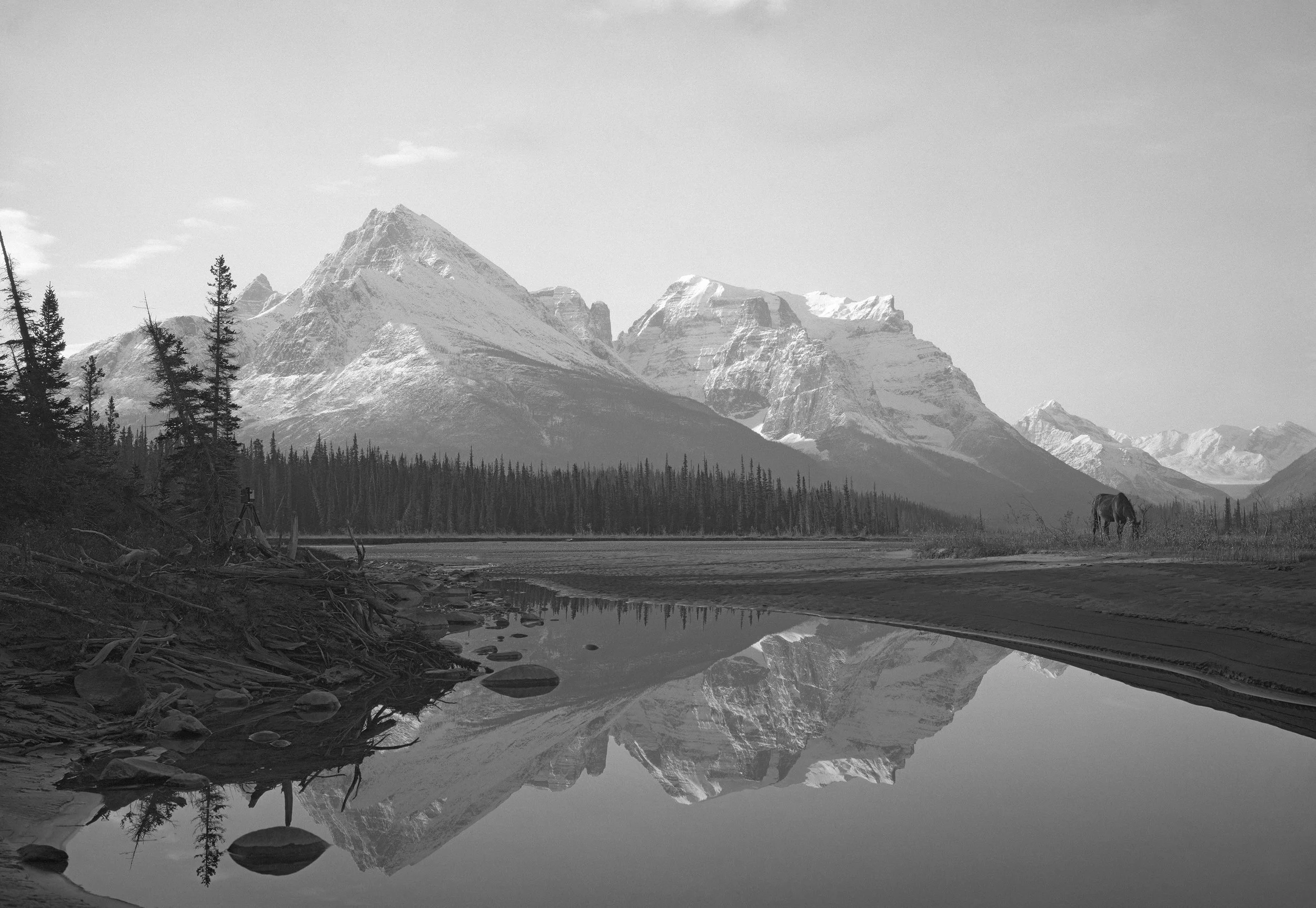
Byron Harmon, 1924, Mt. Quincey