A Canadian Shangri-La
“While we were waiting one of my long-cherished dreams came true. I saw a Swiss guide in the flesh. So many of one’s dreams are spoiled in the realization; but that Guide was, as the Virginian puts it: “better than I dreamed.” He wore the official badge on his coat lapel. He even sported the Tyrolean feather. His boots were as thick and full of nails as I had hoped. He carried an ice axe, a rucksack and a coiled rope. I walked round him at a respectful distance and regarded him from every angle. He was a most satisfying person.”
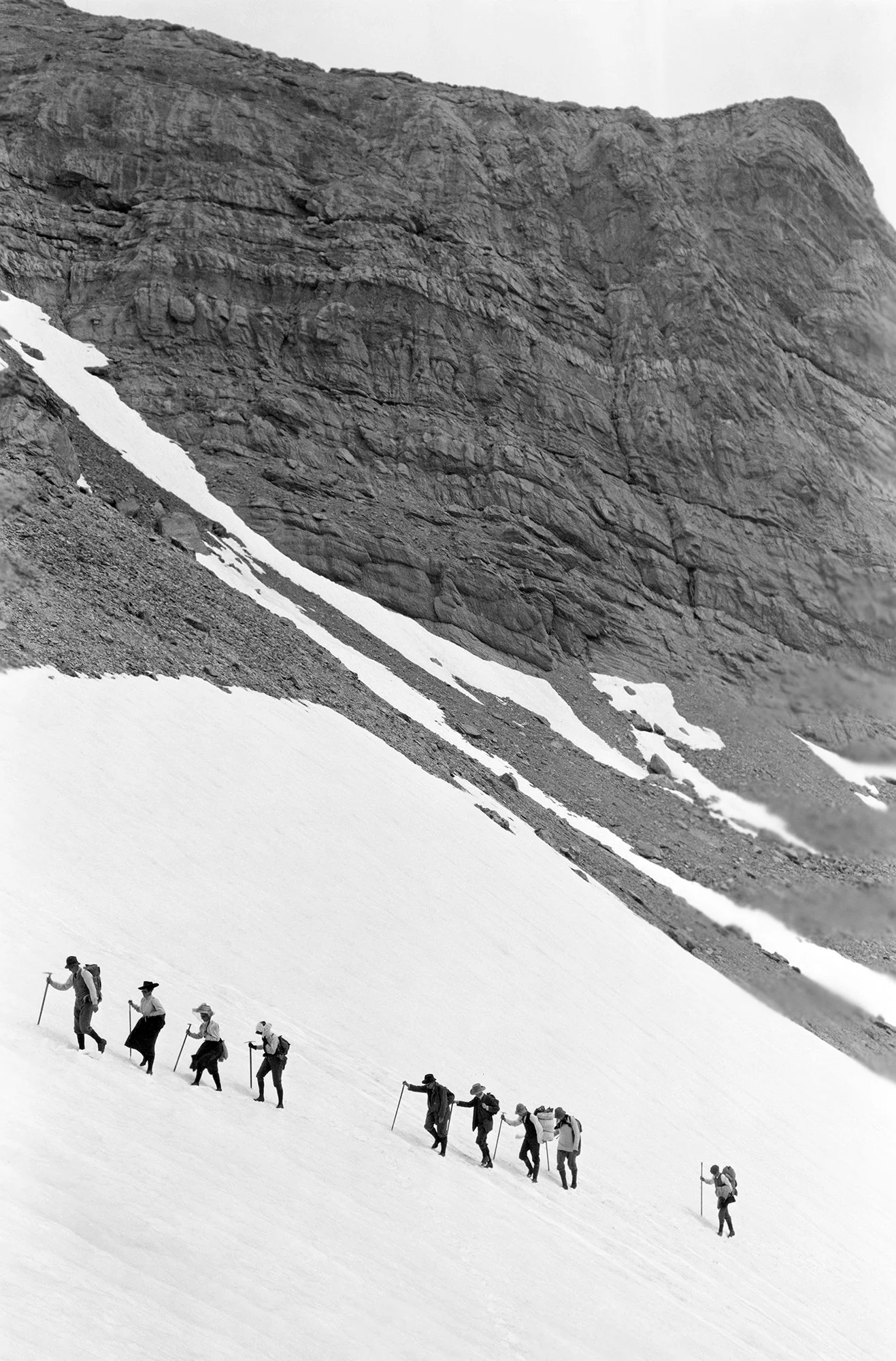
Ascending a Snow Slope, 1909, Byron Harmon
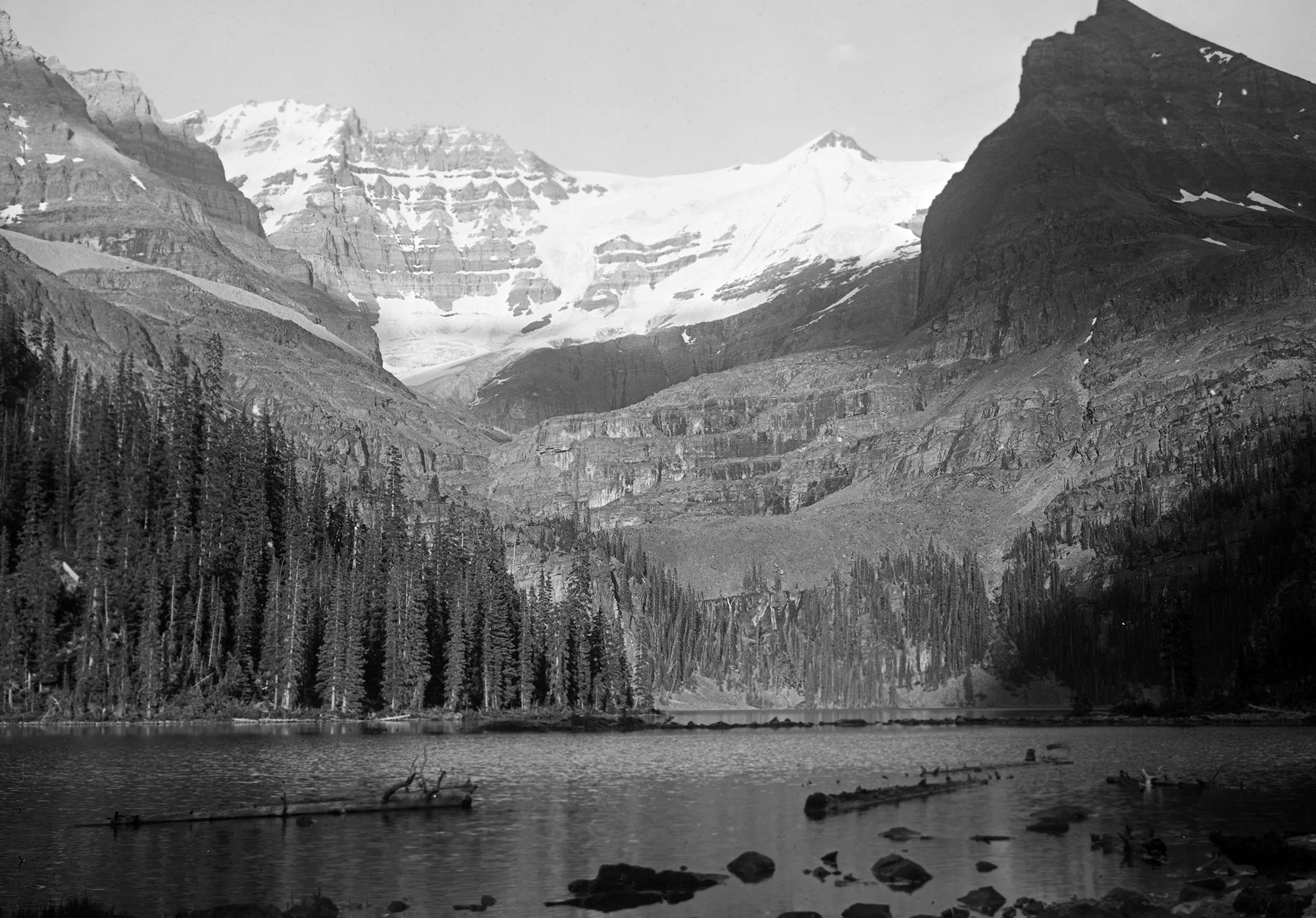
Evening light, Lake O’Hara, 1909, Byron Harmon
On the east side of Mt. Victoria and Mt. Lefroy, lies Lake Louise—the most famous tourist spot in the Canadian Rockies. On the west side lies Lake O’Hara, an insider destination sequestered in an alpine valley, surrounded by peaks, alpine meadows, and small lakes which are connected by a sophisticated system of trails.
In the words of Ethel Johns, a novice climber and newcomer to both climbing and the Rockies, who attended the fourth annual summer camp of the Alpine Club of Canada, held at Lake O’Hara in 1909:
“It is useless to attempt a description of the camp at Lake O’Hara. Those who were there need no description. They have but to close their eyes to see again that mountain meadow, starred with ling, flaming with painter’s brush—its rows of white tents, the shining Adonis pool and all about it the snowy hills of God.”
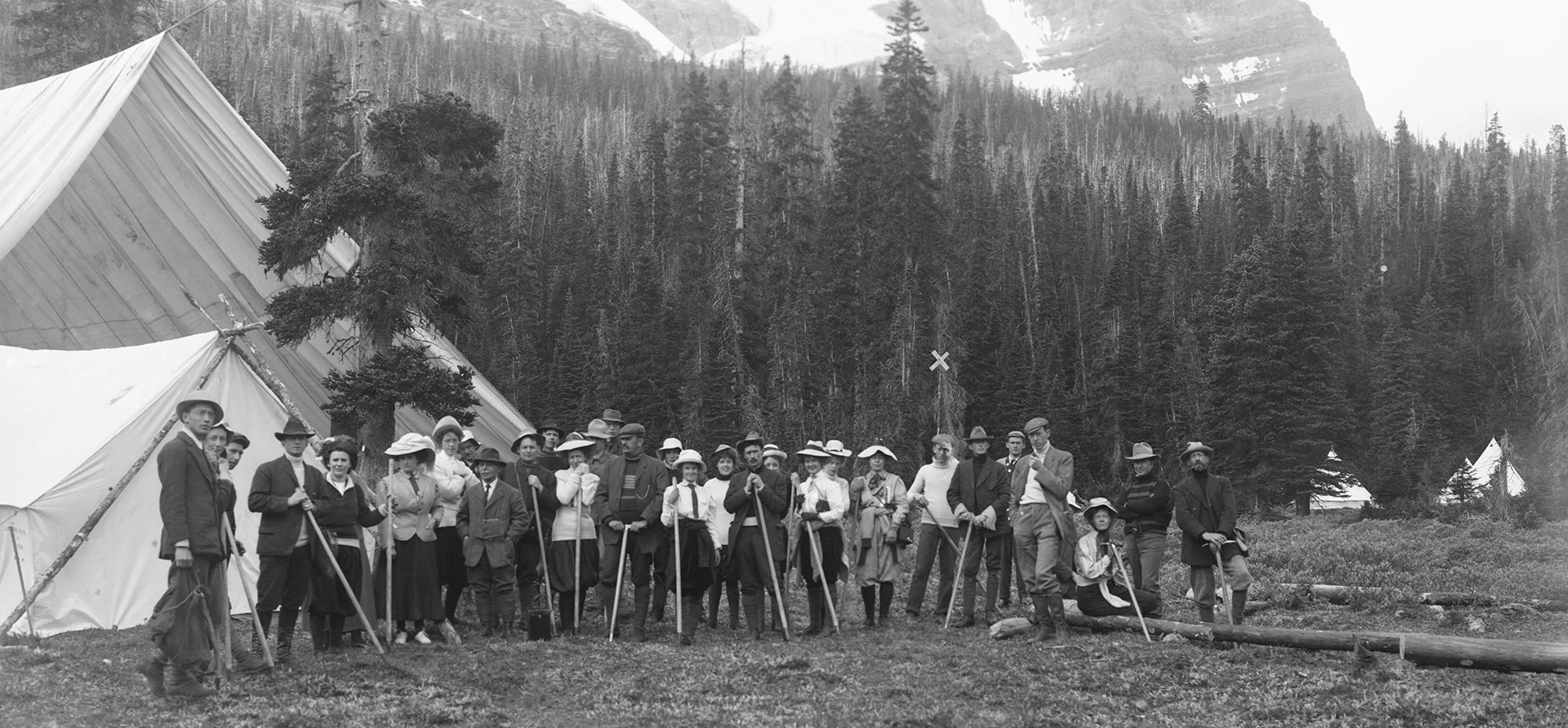
Alpine Club of Canada, camp at Lake O’Hara, 1909, Byron Harmon photo
The colonist history of the lake’s ‘discovery’ credits cartographer Samuel E. S. Allen of Philadelphia, who was exploring and climbing in the Lake Louise area in 1894, with colleagues from Yale who called themselves the Yale Lake Louise Club. He named the lake after an Irishman, Lieutenant-Colonel Richard O'Hara (1835-1924). O’Hara visited the lake in 1889, some historical accounts call Ltd. Col. O’Hara the first tourist to visit the lake.
It’s my contention that Allen and his friends, Walter Wilcox and L.F. Frisell, were the original tourists to this area. Wilcox is credited as the ‘first to see’ Lake Louise, in 1893. He and Allen were serious in their intentions to explore and document the area; sadly, Frisell was injured that first summer and dropped out.
Wilcox was the first to photograph the Lake Louise area. He published his account of their adventures, Camping in the Canadian Rockies, in 1896. Allen mapped the area around Lake Louise, Moraine Lake, and Lake O’Hara, which are connected by alpine passes.
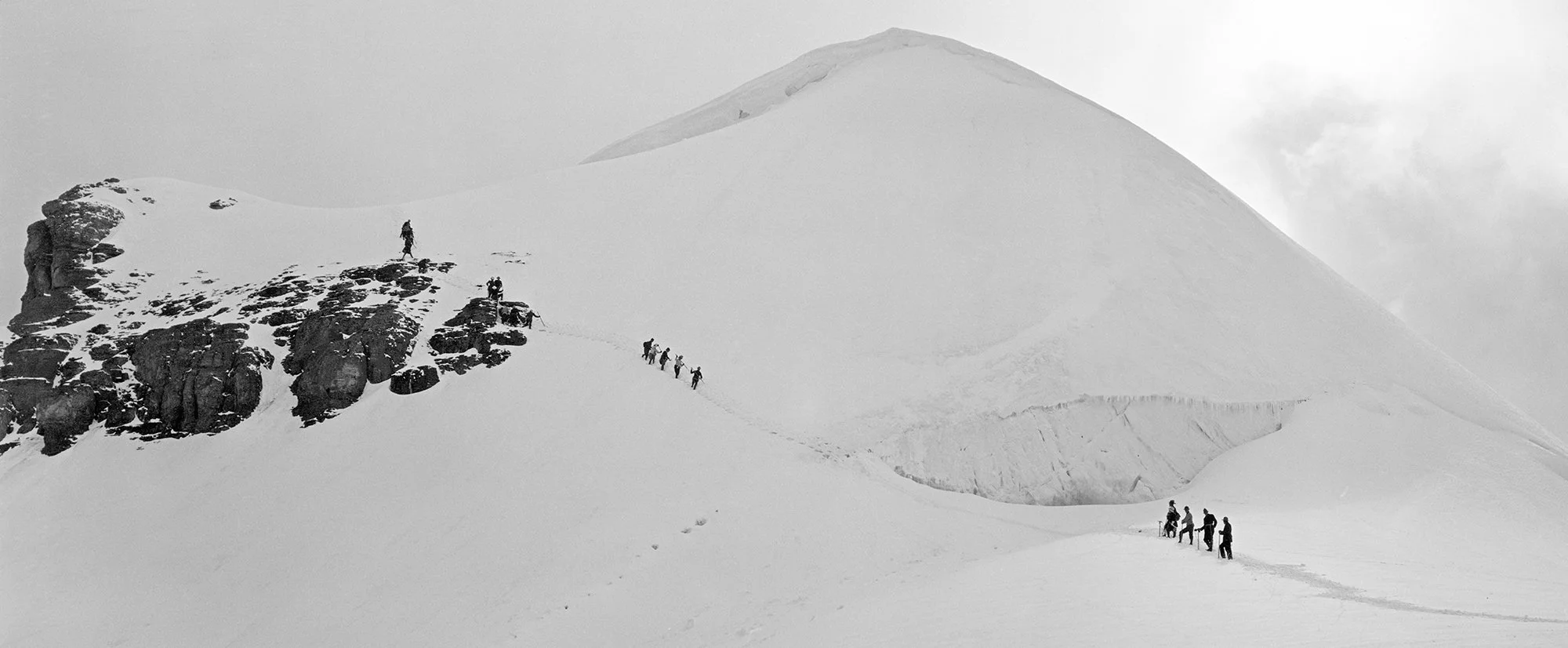
Climbing Mt. Huber, 1909, Byron Harmon photo
The Alpine Club of Canada was the first large group to set up camp near the shores of the lake, as a base for their mountaineering activities. The club had been founded in 1906 and Lake O’Hara was their fourth annual camp. In order to reach the lake, the CPR train was taken west to Hector Station at Wapta Lake. From there, Cataract Brook was followed on foot to the lake, with supplies coming in by packtrain. Today there is a twelve km. gravel fire road which connects the lake with a parking lot near Trans-Canada Highway. It is used to transport, by bus, guests of Lake O’Hara Lodge and those hikers who have made reservations. Cars are not allowed on this road. Many individuals still choose to hike up the Cataract Brook trail or cross-country ski up the fire road in the winter.
In 1909, before the C.P.R had built Lake O’Hara Lodge on the south shore of the lake, before this lodge became privately owned and operated (with permission from Parks Canada), before warden Lawrence Grassi and repeat guest to the lodge, Tommy Link, had built the trail system we presently enjoy, before the Elizabeth Parker hut had been constructed in a nearby meadow to house visiting hikers and mountaineers, before the volounteer organization, Friends of Lake O’Hara, formed to protect the lake and care for the trail system, before they had built a day hut near the lake in co-operation with the lodge, this area was pristine wilderness. There were no trails then, the approaches to the climbs were over boulder fields and up scree slopes, past tiny lakes and alpine meadows.
I continue Ethyl John’s charming account of her experience at Lake O’Hara
“The meadow was intersected by a number of small streams which made the arrangement of the camp very easy. At the upper end lay a tiny pond, around which, in a wide crescent, were pitched, with military precision, the bell tents of the gentlemen’s quarters. The pond was used for performing necessary ablutions and was nicknamed by the lady members «Adonis Pool.»
To the south, across a glade of trees, lay an open glade, carpeted with heather and nicely sheltered. Here, in a symmetrical line, were pitched the tents of the ladies quarters…. Still further south rose the large canopy under which were grouped the cook’s quarters, the dining tables, the tea tent, the post office and order board, and furnished the place of general assembly. In the open in front of the canopy were the office and store tents and the magic fire circle where nightly gathered these worshippers of the hills….Across the meadow, opposite the assembly canopy, the camp of the «Men in Buckskin,» the outfitters and packers of «The Trail.» In odd nooks and corners along the edge of the forest might be seen the scattered white tents of those who preferred being under their own canvas…
The following Alpine Clubs were represented: The Alpine Club, England, The Scottish Mountaineering Club, The Fell and Rock Mountaineering Club, The American Alpine Club, The Appalachian Mountain Club, The Alpine Club of the Netherlands.
Members of the following Learned Societies were present. The Royal Society, The Royal Geographical Society, American Geographical Society, Geological Society, Entomological Society, Entomological Society of America, Linnaean Society.
”
Swiss Guides were employed to lead the climbs. They had been brought from Switzerland each summer by the CPR as a service for guests at its hotels and lodges. Since many of the hotel guests were also attendees at the ACC camps, the CPR provided the guides; who were assisted by more experienced club members.
Mt. Huber was the peak chosen for the graduating climb of 1909. A number of parties undertook this route, each led by a guide. Novices in each party which completed the climb were deemed to have graduated to full member status.
The guide on Ethel John’s graduating climb was Edward Feuz Jr. who she refers to as Edouard. I love her description on first meeting him: