Carole Harmon: Selected Photographs 1979 - 2005

Carole Harmon, 1975, Aileen Harmon photographing Tumbling Glacier
|| My aunt, Aileen Harmon, was a naturalist with Parks Canada and a conservation activist who helped found organizations which are still active today, such as CPAWS, formerly NPPAC (National and Provincial Parks Association of Canada). Tumbling Glacier is a feature of the 55 km. long Rockwall in Kootenay National Park, Canada.
> PURCHASE INFORMATION

Carole Harmon, 1996, Prairie Crocus || Pulsatilla patens, Pasqueflower, or prairie crocus is a harbinger of spring in montane forests in the mountains, the foothills, and across the Canadian prairies. Of the dozens of photographs I’ve taken of this spring beauty, this is my favourite.
> PURCHASE INFORMATION

Carole Harmon 1980, Glacier Des Poilus, Yoho National Park || Glacier des Poilus is one of the glaciers of Waputik Icefield, on the Continental Divide, between Yoho and Banff National Parks, Canada. This viewpoint is reached by climbing through or around the many streams and waterfalls of Waterfall Valley, above Twin Falls. Another image in this collection is of one of these waterfalls.
> PURCHASE INFORMATION

Carole Harmon, Indian Paintbrush in Sunshine Meadows, Banff National Park || Can the name of a wildflower be politically incorrect? If so, Indian paintbrush qualifies. Castilleja, of which the plant in this photograph is one of two hundred or so species, is native in northern eco-systems around the world. The lower elevation orange paintbrush is also known as prairie fire. Alpine varieties, such as this, are found in a range of colours from pale pink to deepest burgundy,, white and pale yellow.
> PURCHASE INFORMATION
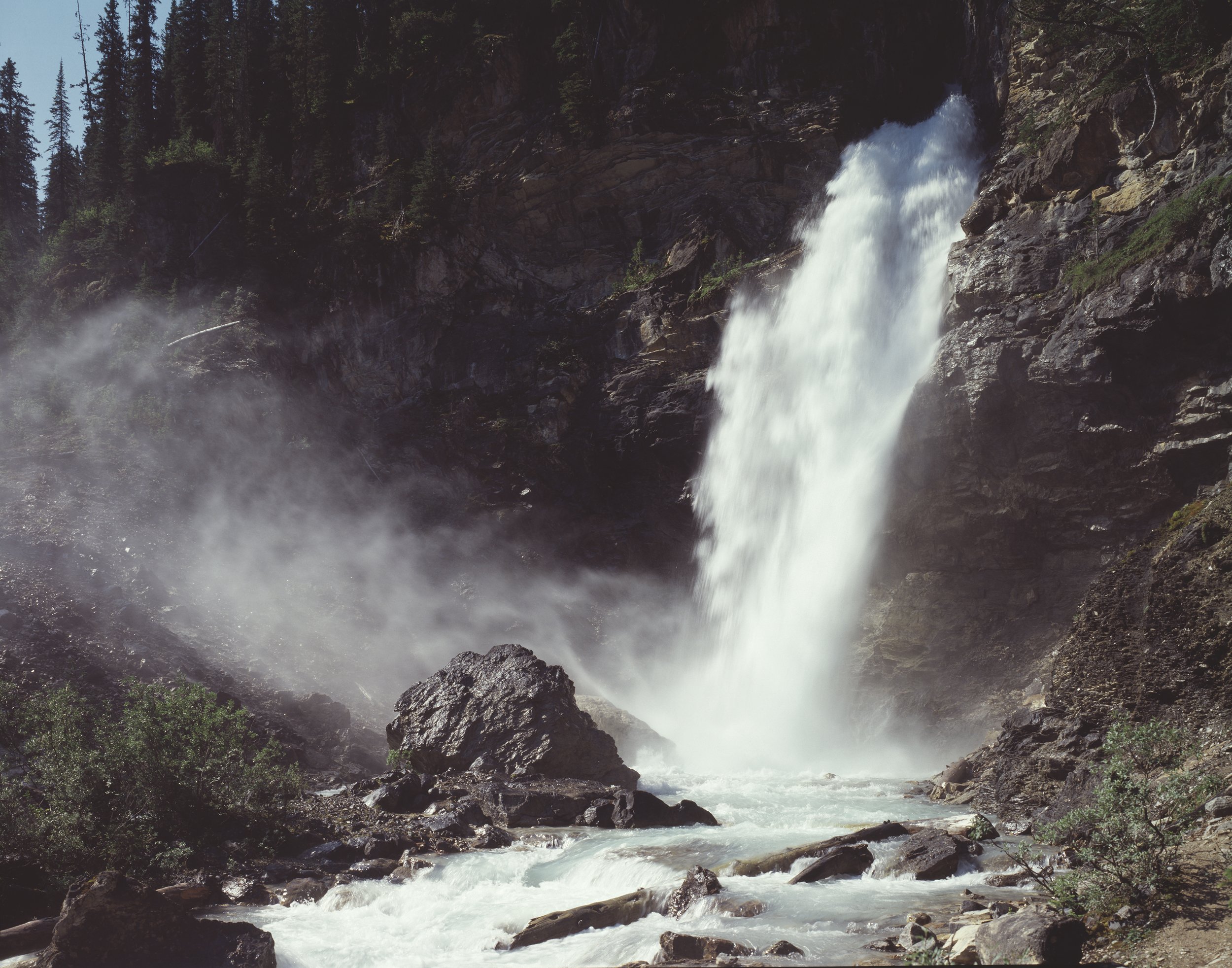
Carole Harmon, 1981, Laughing Falls || Laughing Falls, in Yoho Valley, Yoho National Park, Canada, seems to spring from the rock but its water is channeled through a narrow gorge from glaciers above.
> PURCHASE INFORMATION

Carole Harmon, 1981, Maligne Lake at sunset, Jasper National Park || Twenty-two km. long, Maligne Lake is the largest natural lake in the Canadian Rockies. Many of the mountains and features surrounding the lake were named by author, botanist and photographer, Mary Schäffer Warren, who is credited with being, in 1907, the first white woman to see the lake. She returned to the Rockies to heal her heart after losing her first husband, botanist Charles Schäffer, and married her guide, Billy Warren.
> PURCHASE INFORMATION

Carole Harmon, 2002, Mt. Rundle from first Vermilion Lake || This view of Mt. Rundle from Vermilion Lakes is famous. It is actually a view of one end of this mountain which is a massive wall of rock extending over twelve km. (7.5 miles) between Banff and Canmore in the Canadian Rockies. It has been referred to as a small mountain range and has seven distinct peaks.
> PURCHASE INFORMATION

Carole Harmon, 1981, Mt. Walker, Mt. Bulyea, South and North Mt. Pilkington from Niverville Meadow, Banff National Park || The Freshfields are a group of peaks south of Columbia Icefield on the Alberta/BC. border in Canada. Named 1n 1897 by Norman Collie for British climber Douglas William Freshfield, the Freshfields contain one of the largest glacial systems in Western Canada, crowned by jagged 10,000 to 11,000-foot peaks which surround tiny Niverville Meadows where we camped. All the peaks in this group are named for climbers.
> PURCHASE INFORMATION

Carole Harmon, 1979, On Panorama Ridge, Banff National Park || I named this Peak Abu, when I took the photograph. We were there in September when the turning Lyell’s larch were at their golden finest.
> PURCHASE INFORMATION

Carole Harmon, 1968, Opabin Plateau || I was camping with friends in a meadow near Lake O’Hara. I woke early and climbed to Opabin Plateau for early morning photographs. The plateau is covered with ledges and lakes, larch trees, and wildflowers in summer.
> PURCHASE INFORMATION

Carole Harmon, 1979, Poet Jon Whyte on Numa Pass, Kootenay National Park || Banff native, Jon Whyte (1941 - 1992), has been referred to as the Bard of Banff. Much of his poetry and non-fiction commemorates the history, geology, and beauty of the Canadian Rockies. Numa Pass is on the Rockwall in Kootenay National Park, Canadian Rockies.
> PURCHASE INFORMATION

Carole Harmon, 2004, River Beauty, Kootenay River || A relative of the taller fireweed, river beauty grows along waterways whereas fireweed is one of the first plants to regenerate after wildfire. Chamaenerion latifolium is also known as broad-leaved willow herb. I took this photograph near Kootenay River after wildfires in 2004 had bared the mountainsides above.
> PURCHASE INFORMATION

Carole Harmon, 1994, Shooting Star || Dodecatheon are members of the primula family which grow widely in North America. They are a perfect example of Goethe’s idea that the appearance of a plant may signal its nature and practical uses. Many common names for plants have been chosen with this in mind, as to appearance but also herbal properties.
> PURCHASE INFORMATION

Carole Harmon, 1980, Waterfall Valley, Yoho National Park || Above Twin Falls, Waterfall Valley is scoured by seasonal avalanches and meltwater. There is a narrow trail up the side of the valley or you can pick your way through the many streams, pools and waterfalls to Glacier des Pools above. It’s a truly remarkable landscape.
> PURCHASE INFORMATION

Carole Harmon, Western Wood Lily || Some exquisite mountain wildflowers are too tiny to be photographed. Not so the glorious wood lily, or red lily, Lilium philadelphicum. Like so many mountain wildflowers, it also grows across the prairies with no respect for ideas of ‘native’ or ‘territory’. In Waterton National Park, for instance, plants from the prairies, British Columbia, and the Rockies have gloriously co-habited making this one of the most species rich locales for wild plants in Canada.
> PURCHASE INFORMATION

Carole Harmon, 1995, White Bog Orchid || One of the Habinaria family, wild orchids are vulnerable to climate fluctuation, territory loss, and changes to the soil, much of their survival depends on microscopic fungi in the soil. Orchids depend on the symbiotic relationships they form with these fungi to obtain nutrients. The abundant clumps of orchids I knew growing up are disappearing.
> PURCHASE INFORMATION

Carole Harmon, 1996, First Welsh Lake, Purcell Mountains || First and Second Welsh Lakes collect meltwater from the Irish Peaks. These lakes are surrounded with rubble, debris deposited in lateral and terminal moraines by former great glaciers.
> PURCHASE INFORMATION

Carole Harmon, 1996, Morning Reflection in First Welsh Lake || I backpacked to the Welsh Lakes in the Purcell Mountains with my children, Sebastian and Julia Hutchings. I loved this reflection of sunrise on a cliff near our camp by First Welsh Lake.
> PURCHASE INFORMATION

Carole Harmon, 1996, Yellow Ladyslippers || Cypripedium calculus, also known as yellow moccasin flower, flourishes where meltwater from the surrounding glaciers enters Emerald Lake, in a braided stream system, sometimes growing through the nutrient rich shallow water.
> PURCHASE INFORMATION

Carole Harmon, 2003, Tokkum-Verendrye Wildfire, Kootenay National Park ||
Photographed from Banff-Windermere Highway near Kootenay Crossing on the Banff Windermere Highway.
> PURCHASE INFORMATION

Carole Harmon, 2004, Fireweed Gazes at Last Year's Wildfire || Chamaenerion angustifolium, is one of the first plants to appear after wildfires, beginning the process of regeneration and new life. This photograph was taken in Kootenay National Park one year after the Tokkum-Verendrye wildfire burned 12% of the park in 2003.
> PURCHASE INFORMATION

Carole Harmon, 2004, Tokkum-Verendrye Wildfire landscape one year later || This wildfire burned 12% of Kootenay National Park in 2003, photo of Kootenay River and surrounding burn.
> PURCHASE INFORMATION
